
本記事の、日本語翻訳版はこちら
Introduction
Hello! We are Refik, Hamza, and Oguz.
We work at DOCOMO Euro-Labs (EUL), docomo’s centre of excellence of global telecom standardisation in Munich, where we study virtualized, automated, and data-driven mobile network management. Our activities span from research to international standardization in 3GPP and O-RAN, with the goal of shaping practical and trustworthy network autonomy for future generations. In this blogpost, we wanted to share our view on autonomous agents in network management systems, how they will impact and what would be the operator’s needs to have autonomous agents running in the networks. This article is for anyone involved in operating, designing, or standardising mobile networks who wants to understand what true autonomy in 6G network management really means for operators.
We also appear in our youtube videos too, please have a look!
In today’s multi-vendor networks, automation is like owning a robot that does the job but still needs your guidance before doing anything. Moreover, each automation platform may speak its own language, the network may change faster than your scripts, and every layer from hardware to cloud may add another puzzle piece that may not quite fit.
In 5G network management systems, we, network operators, do have automation functions, but true autonomy would require systems that understand the operator’s expectations, adapt themselves and safely make decisions without constant babysitting and this is something currently missing. Until networks can think for themselves end-to-end, in a trusted way, operations engineers need to remain the overly caffeinated translators keeping the networks running. That’s why it is important that 6G network management systems enforce common standards, enabling smooth, reliable autonomous operation and giving operators confidence in the system.
- Introduction
- 1. What We Have Today: Network Management Automation
- 2. Operator needs for 6G network autonomy:
- 3.Deployment Options: Where can these agents live?
- 4.Towards 6G: Autonomous Network Management with full trust of the Operators
1. What We Have Today: Network Management Automation
3GPP is a global organization where companies come together to agree on the technical “rules” that make mobile networks and devices work smoothly worldwide. It can be basically considered as one of the international blueprint-makers that ensures your phone’s magic works. 3GPP SA1, one of the working groups of 3GPP, defined an AI Agent as " an automated intelligent entity that achieves a specific goal (autonomously or not) on behalf of another entity, by e.g. interacting with its environment, acquiring contextual information, reasoning, self-learning, decision-making, executing tasks (independently or in collaboration with other AI Agents)”. This definition helps align how AI agents for 6G networks are understood and standardized across 3GPP working groups. Using this definition, an example of the interactions of AI agents is illustrated in the Figure below.
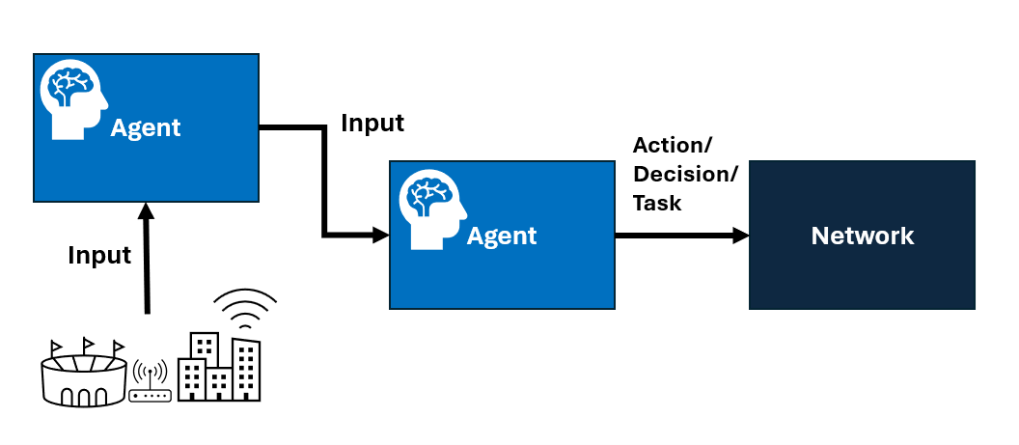
3GPP SA5 is responsible for how mobile networks are managed, and maintained, creating the standards that keep networks managed, controlled, and thus functioning efficiently. Therefore, in preparation for 6G, 3GPP SA5 is going to explore the use of AI agents as intelligent network managers to ensure efficient and reliable operation. Considering the definition of AI Agents by 3GPP SA1, some Management Service (MnS) specifications already satisfy this definition. For example, Intent Handling Functions (IHF) in 3GPP SA5, which have been specified since Rel-17, achieve a specific goal of another entity (which can be called MnS consumer). These goals are formally specified as intents, which include standard expectations such as radio network expectation, core network expectation, radio service expectation, network maintenance expectation. Therefore, an IHF can be considered as an agent or a collection of agents working together to fulfil an intent. Furthermore, an IHF can also coordinate with other agents. Another example of MnS producers that are specified by 3GPP SA5 and fits the description of AI agents is Closed Control Loops (CCL). A CCL performs monitoring, analysis, planning actions and execute these actions and can be realized as one or multiple agents. Management Data Analytics (MDA) MnS producer, can also be considered as an AI agent, as it provides reasoning and inference for certain tasks.
Not only 3GPP SA5 works on how to enable network management automation. O-RAN Alliance, which is an international industry consortium that works to transform traditional mobile networks into open, intelligent, virtualized, and interoperable RAN networks also works on a standardizing service management and orchestration within RAN networks. Towards this goal, O-RAN introduced rApps, non-real-time RAN Intelligent Controller (RIC) applications that performs non-real time optimization, policy management, AI/ ML based analytics.
So what will be really different in 6G, as these capabilities are already satisfied by certain functions and applications in 5G Network Management systems? The answer is full autonomy, as a driver for more efficient and optimized network operations. In many cases, these automation functions/applications will leverage advanced AI/ML models. They will need to update their internal knowledge and dynamically adapt to the changing conditions. So that certain level of autonomy can be achieved, while minimizing human intervention in the operations.
However, when everything goes autonomous, the operators' problems will not disappear. The main challenge for operators running autonomous networks is the loss of visibility. Especially while handling emergencies, operators need instant control. Without proper tools, autonomous networks risk turning into a sitcom of chain reactions: Agent A influences Agent B, Agent B triggers Agent C, Agent C misreads KPIs, and the butterfly effect follows.
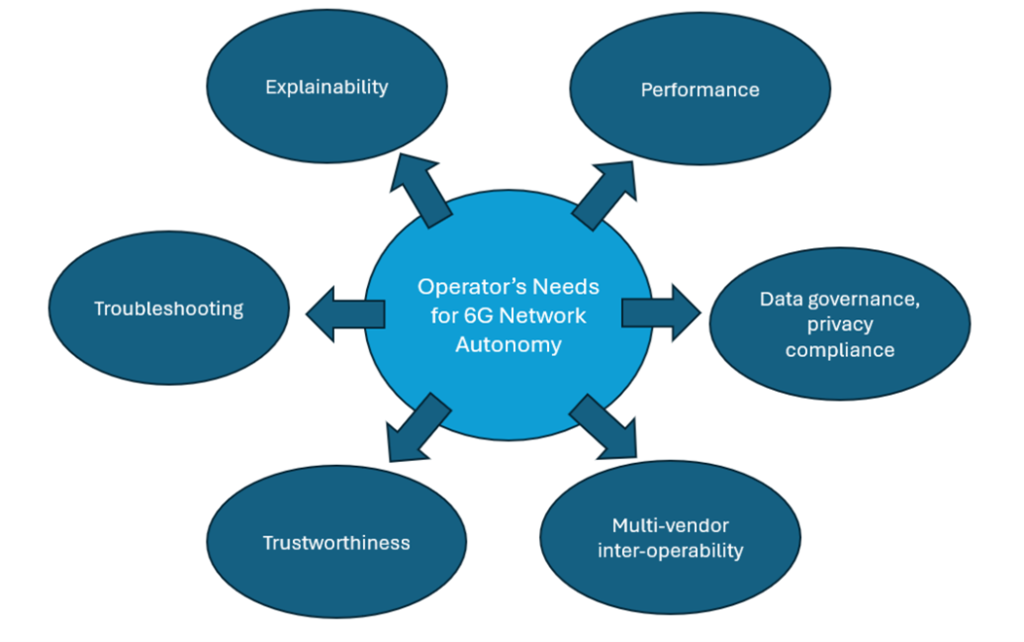
2. Operator needs for 6G network autonomy:
Explainability
Explainability is all about turning AI/ML models from mysterious “black boxes” into systems that humans can understand. Explainability for AI agents should help the operators understand the agent’s decision-making. With proper explainability, the operators can trace the logic behind an algorithm’s behavior instead of taking its output as “magic”. Recent efforts in 3GPP SA5 to define attributes for ML inference explainability provide a good starting point, but they remain far from sufficient for real-world explainability needs, especially in complex, autonomous 6G management systems that would require more detailed information about:
- What interactions or causal relations influenced the decision (for example interactions with another AI agent)
- Whether the model behaved differently depending on context
Autonomous AI agents in 6G network management systems must justify decisions across dynamic conditions, multi-model, multi-vendor pipelines. Decision traceability in autonomous 6G network management requires the ability to reconstruct the full reasoning chain: which agent or model was triggered, what intermediate decisions were taken, what actions to apply to the networks (e.g. configuration change) were derived.
Troubleshooting
Troubleshooting in network management is the systematic process of detecting, diagnosing, isolating, and resolving issues within a network to restore or maintain normal service operation and meet service-level objectives. The operator follows the clues from alarms; strange performance drops and traces the trouble to the misbehaving component and fixes it so the whole network can get back to normal operations. Since autonomous agents are expected to make decisions based on real-time data and learned behavior, the first step for troubleshooting them is to check whether they’re understanding the environment correctly: the operator needs to verify their inputs, data pipelines, telemetry feeds, and sensors. If an autonomous agent is acting unexpectedly, the operator needs to look for signs of model drift and corrupted data.
Because the autonomous agents are expected to work with other agents, the operator needs to check for policy conflicts between these agents, and if necessary, decides to fall back to safe-mode operation while preserving service continuity.
Trustworthiness
Trustworthy Machine Learning is a very important requirement from an operator perspective across the ML training, testing, and inference phases (which are specified in 3GPP TS 28.105) and becomes even more critical when embedded in autonomous agents. These autonomous agents operate with varying degrees of autonomy, making decisions without continuous human intervention. Because their actions directly impact network operations, the ML components powering them must be explainable, fair, and robust. Regulatory guidance such as the EU AI Act and ISO/IEC standards outline key trust dimensions, including transparency, non-discrimination, technical robustness, and human oversight, which must be applied consistently throughout the ML lifecycle. To achieve this, operators rely on trustworthiness indicators which must be standardized for example explainability indicators, fairness indicators and robustness indicators. Fairness indicators evaluate whether the agent’s decisions disproportionately affect specific groups, or even specific vendor product, using measures such as disparate impact or average odds of difference. Robustness indicators ensure the agent can function reliably under conditions such as missing data, noise, or changing environments. As operators, we would like to have clear, standardized trustworthiness indicators, because if we’re going to let autonomous agents run around our network operations, we’d like to trust them as much as we trust our best engineers.
Multi-vendor interoperability
In 5G, automation struggles in multi-vendor environments because management functions, policies, and data models are exposed differently across vendors. Even with the current standards, interpretation gaps remain, leading to incompatible data schemas and processes that cannot coordinate reliably across domains. As networks evolve toward cloud-native and AI-driven architectures, this fragmentation becomes even more apparent. Autonomous agents from different vendors need to perceive the network in a consistent way and exchange their decisions in an understandable form. Without this deeper level of interoperability, agents behave as isolated components rather than collaborators, resulting in conflicting actions and unpredictable behaviour of the networks. They also need to be managed in a standardized way to ensure consistent lifecycle handling, governance, and operational control across the ecosystem.
Security by design
As networks move toward autonomy, security must be built in from the start rather than added later. In 6G, autonomous agents will analyse data, make decisions, and act without constant human intervention, which means any problem in data, models, or communication channels becomes an operational risk. Attacks no longer need to target traditional network nodes because the compromised training data, manipulated inputs, or spoofed messages between agents can be enough to cause disruptions. This requires every agent to include strong authentication, integrity checks, access control, and continuous trust validation.
Data governance, privacy compliance
As autonomous agents become important for 6G networks, the amount and sensitivity of data they use increases exponentially. This makes strong data governance essential. Operators need clear rules for how data is collected, labelled, shared, and retained, along with standardized metadata, data flow tracking, and strict access control. These rules ensure that agents receive reliable, high-quality data without exposing sensitive information or crossing organizational boundaries. Privacy compliance is equally critical under regulations like GDPR, the EU AI Act, and telecom specific data protection rules. Autonomous agents must apply data minimization, anonymization, and purpose limitation. They should still function effectively even when direct access to raw data is limited, using approaches such as federated learning, differential privacy, or secure aggregation.
Performance constraints
Autonomous agents in 6G may need to operate within strict performance limits, often making decisions in milliseconds, with much more strict latency requirements than current network management systems due to support new 6G use-cases. Accuracy is equally important. Incorrect predictions can trigger unnecessary actions or worsen service quality. Reliability is another key factor to complete a strong AI framework. Agents must behave consistently under varying load, failure events, and unpredictable conditions.
3.Deployment Options: Where can these agents live?
As networks evolve toward autonomy, one of the biggest practical questions becomes: where should these agents actually run? Their location determines how fast they can react, what information they can see, and how safely they can collaborate with the rest of the system. In 6G, we expect agents to live in different parts of the network depending on their purpose, some acting as global planners, others as ultrafast responders, and still others coordinating everything in between. Choosing the right deployment model directly affects autonomy, safety, transparency, and the operator’s ability to stay in control.
Centralized Agents
Centralized agents live (run) in the operator’s cloud or central management systems, where they act like strategic planners with full visibility of the network. They benefit from more compute resources capacity and can coordinate decisions across domains, vendors, and layers.
Distributed Agents
Distributed agents live closer to the action, inside RAN nodes, edge clouds, or even embedded in network functions, giving them the speed and context to act instantly when conditions change. Together with centralized agents that provide brain-like intelligence, distributed agents can act as the network’s nerves, enabling rapid, context-aware actions at the local level.
Other Deployment Considerations
Furthermore, the agents may even collaborate across operators through federated or privacy preserving methods, or train and validate their decisions inside digital twins before ever touching the real network. These deployment options give operators much finer control over how autonomy is introduced, letting them balance performance, governance, and safety in a practical way.
4.Towards 6G: Autonomous Network Management with full trust of the Operators
In conclusion, getting from today’s rule-driven automation to truly autonomous 6G network management takes much more than smarter algorithms. It requires solid foundations: clear explainability, easy troubleshooting, trustworthiness, security by design that works according to their performance expectations, consistently across vendors and network layers with more stringent performance requirements. Autonomous agents can only become genuinely useful when operators can understand why they make certain decisions, follow how they interact with other agents, and trust that their choices are fair, secure, and aligned with their expectations. To make that possible, SDOs, such as 3GPP and O-RAN, need to provide standardized, meaningful solutions that expose an agent’s reasoning, verify its behaviour, and ensure it adapts safely as the network evolves.
Our expectation from 6G Network management is to shape full autonomy from a mysterious black box into a transparent, dependable partner in our daily operations. When AI agents can clearly explain their actions, handle real-world complexity, and work seamlessly across multi-vendor environments, autonomy becomes something operators can truly rely on. With clear 6G standards addressing the operators’ requirements, autonomous agents can grow from unpredictable sidekicks into collaborative co-workers, helping operators run networks more intelligently, more safely, and with a lot less caffeine.
